



 Back to all articles
 What Soft Furnishings Does a Luxury Holiday Home Actually Need?
The linen, layering, light control and considered details that make an exceptional home feel effortless.
An owner can spend three years on a build, another year on the landscaping, and then hand the whole thing over to a guest who will form their entire opinion of it in the first four minutes.
They will remember the bed, the weight of the towels, whether the room was dark enough to sleep in and whether something in the house suggested that a person had been there recently and cared.
Kit Kemp put it beautifully: rooms “should not feel too laboured or serious; they should look artless, even if a great deal of thought has gone into them.” That gap—between how much thought goes in and how little of it shows—is the whole discipline of soft furnishings.
Start with the Linen—and Ignore the Number on the Packet
White is almost always the right choice, and for an unglamorous reason: white can be treated. A wine mark on white cotton can be soaked, washed and returned to service. The same mark on a soft grey sheet can retire it. White is less a design choice than an asset-protection decision that happens to look beautiful.
Thread count is where many owners are quietly misled. In 2005, the United States Federal Trade Commission warned the textile bedding industry that multiplying the actual thread count by the number of plies in a yarn could mislead consumers. Consumer Reports’ textile experts put the useful ceiling around 400, while Consumer NZ similarly notes that fibre quality, ply, weight and weave matter more than the number.
Two examples settle the point. Four Seasons sells a pillow with a 240-thread-count cotton cover. Frette, which supplies leading international hotels, publishes no thread counts in its fabric guide and sells on fibre and finishing instead.
Look at fibre length rather than thread count. Long-staple and extra-long-staple cotton has fewer fibre ends per length of yarn, which means fewer ends to work loose, tangle and pill. That is why good cotton can still look good after eighty washes while ordinary cotton looks tired after twenty.
On weave, percale is crisp, cool and plain-woven, and it holds a press. Sateen is heavier, silkier and warmer. It releases wrinkles more easily but is generally less durable because of the floating yarns on its surface. Linen is worth serious consideration for a property with a short turnaround and an off-site laundry because linen creases by design. Where cotton looks neglected when rumpled, linen looks intentional.
Presentation Is a Technique, Not a Talent
Crispness on a bed comes from pressing. In hotels, the flat sheet passes through a flatwork ironer, which is why the fitted sheet is generally not pressed at all. In a private home, the practical version is to iron the fitted sheet in place once it is on the mattress, section by section, and press the flat sheet off the bed where there is room to work. Make the bed immediately after pressing so the linen does not sit folded and re-crease.
For whites, resist the instinct to reach immediately for chlorine. Repeated harsh bleaching stresses the fibre and accelerates the ageing that causes yellowing. Oxygen-based products are the sensible routine. They are better at maintaining whiteness than restoring it, which is another argument for treating marks early rather than heroically.
Mattress and pillow protectors should remain on at all times and be laundered on a documented rotation rather than when someone remembers. Their practical job is simple: a protector stands between a guest and a mattress that can cost several thousand dollars to replace, while keeping that mattress inspectable.
New Zealand properties using an external laundry with a 48-to-72-hour turnaround need roughly three and a half to four sets of linen per bed in circulation, rather than the three sets a property with its own machines can often manage. Remote coastal and lakeside homes routinely run short here.
Then Build the Layers
A bed that photographs well and a bed that feels good to get into are the same bed. Both are built in layers. Four sleeping pillows are a sensible base. Match the shams and cases to the bed width so the pillows fill the headboard rather than floating in the middle of it.
Fold a quilt or coverlet neatly across the bottom quarter of the bed. In hospitality, this piece is often called a bed scarf, and it is the most practical piece of linen on the bed, not the least. Every guest puts a suitcase on the bed; the scarf is what takes it.
Add a throw with a different hand to everything beneath it: wool against cotton, bouclé against percale, something with a little weight. Run it across the end of the bed so it drapes on both sides rather than sitting square. Finish with cushions in an odd grouping of three or five.
Whether to triple-sheet or use a duvet inside a removable cover is a property-by-property decision driven by laundry operations rather than taste. Triple sheeting assumes hotel infrastructure: trained housekeepers, generous linen stock and supervisors checking rooms. In a holiday home with a contract cleaner and a four-hour turnaround, a removable duvet cover is a clear rule everyone can follow—and consistent execution is worth more than a technique nobody applies properly.
If you list on Airbnb, select the extra pillows and blankets amenity and make sure they are stored somewhere obvious.
The guest remembers the bed, the weight of the towels and whether the room was dark enough to sleep in.
The One That Costs Reviews: Light
New Zealand is further south than many guests expect, and summer evenings run long. At the end of December, the sun sets around 8:42 pm in Auckland and closer to 9:36 pm in Queenstown, with sunrise in Southland arriving before six in the morning. Peak season and peak daylight are precisely the same weeks.
A guest who cannot sleep past 5:50 am does not write a review about the light. They write a review about being tired. Every bedroom needs a genuine blockout option, and it must work at the edges of the window as well as in the middle. A bright line down the side of a blind is often what actually wakes people.
Airbnb currently offers a “room-darkening shades” amenity rather than a specific blackout option. Describe genuine blockout curtains or blinds clearly in your own listing copy rather than relying on the platform tick box to explain the standard.
Beyond the Bed
Towels
Provide enough towels to hang neatly on the rails without crowding, plus additional towels folded at the foot of the bed or on a stool in the room. The folded set reads as generosity. A crowded rail reads as a full house.
Water
Use glass rather than plastic: a small glass bottle on each bedside table, or a carafe with the tumbler inverted over the neck. It is a tiny thing, and guests notice it every time.
Artwork
Large pale walls need breaking up, and the most common mistake is hanging something too small. A useful convention is that artwork over a sofa or bed should be around two-thirds the width of the furniture below it, with roughly 15 to 20 centimetres of breathing space between the frame and furniture. The familiar eye-level rule of about 145 centimetres to the centre is a starting point and may need lifting in a room with high ceilings.
Surfaces
Designers call a considered grouping of objects a vignette. Vary the heights and materials, anchor the grouping on a tray and leave part of the tray empty. Step back from the arrangement, then add and remove until it settles. Three objects usually sit more comfortably than four, and the empty space signals confidence and restraint.
Books
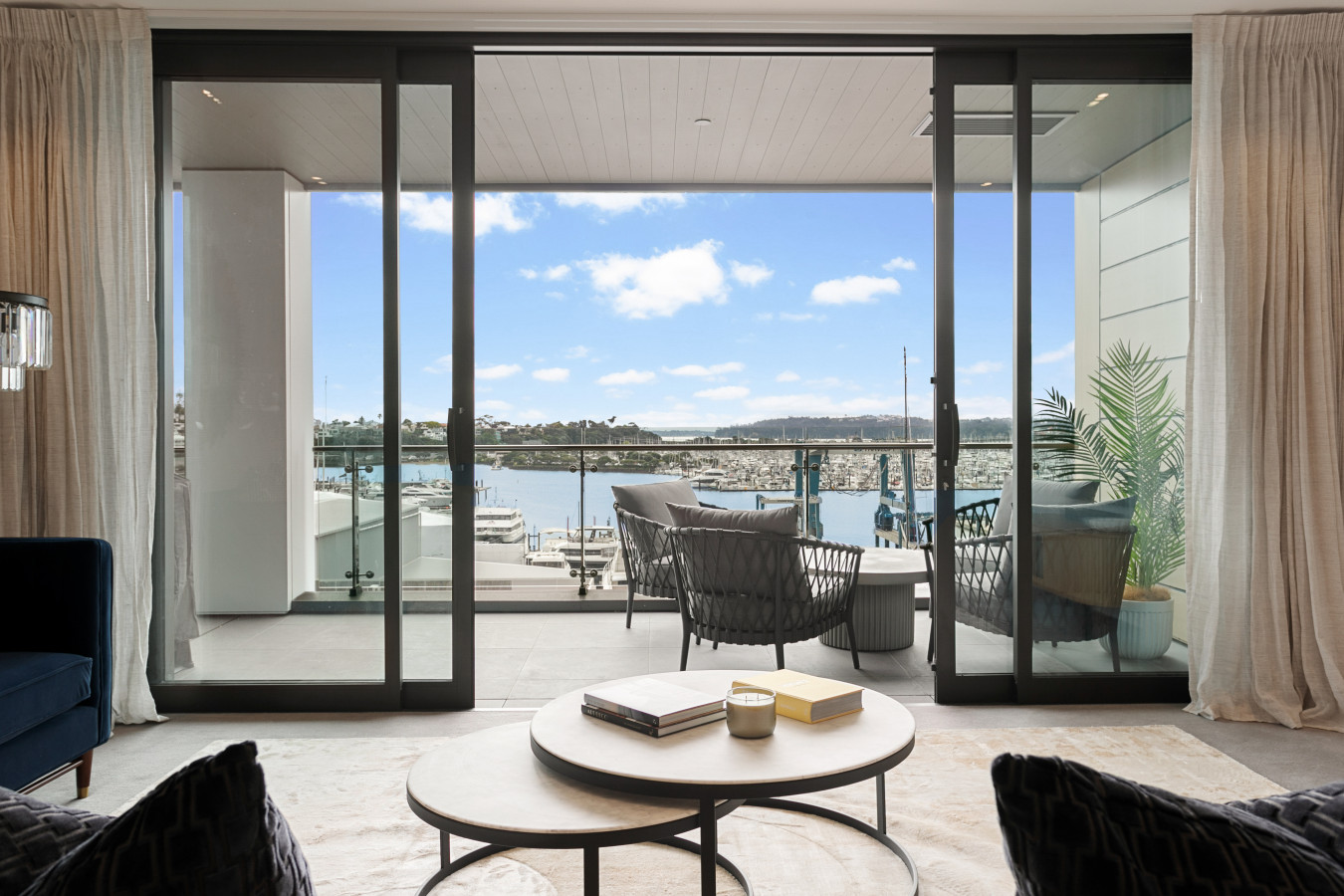
Books are where a home either says something or says nothing. Books chosen for their spine colour are obvious immediately; books chosen for the place are not. New Zealand publishes exceptional work on local photography, architecture, landscape and art. If you have a New Zealand artist on the wall, placing a thoughtful monograph on the coffee table completes the idea.
Consider titles such as New Zealand Photography Collected: 175 Years of Photography in Aotearoa by Athol McCredie, Herbst: Architecture in Context, landscape work from Potton & Burton, Peter Simpson’s volumes on Colin McCahon or Jill Trevelyan’s Rita Angus: An Artist’s Life.
Living rooms
Place throws over sofa arms and use cushions in varied textures rather than a matched set. The aim is a room that invites someone to sit down rather than one that looks assembled only for a photograph.
Flowers and greenery
Something alive changes a house more than almost anything else on this list. It does not need to be florist work. A few stems of magnolia, camellia or pittosporum from the garden in a good vessel can be enough. Pittosporum is particularly reliable as cut foliage.
For a property that sits empty for long periods, there is no shame in using a good faux option in locations where a living plant will not survive. The goal is not to prove the greenery is real; it is to preserve the feeling of care.
Arrival
If it suits the property and its pricing, the arrival moment returns more goodwill than almost anything else you can spend on. Fresh milk in the fridge. Water already cold. Fruit in the bowl. A charcuterie board for guests arriving late from an airport—which describes a large share of Queenstown and Bay of Islands arrivals.
None of it is necessarily expensive. All of it says the same thing: someone knew you were coming.
The Point
Every element here is small. That is precisely why it works. A guest may not be able to articulate why one home feels considered and another feels merely expensive, but they feel it before they have put their bag down, and they write about it afterwards.
The properties that hold their rates through a soft season are rarely just those with the best view. They are the ones where the bed was right, the room was dark, the towels were generous and something in the home suggested that a person had thought about it. That is not decoration. It is stewardship, and it shows.
Let us review how your home should be presented
If you have built or bought something you care about and are weighing up how it should be furnished, presented and positioned for guests, the Stay Luxe team would be glad to talk it through with you.
By Stay Luxe